Does Bookmarking a Website in Chrome Affect Google Search Rankings?
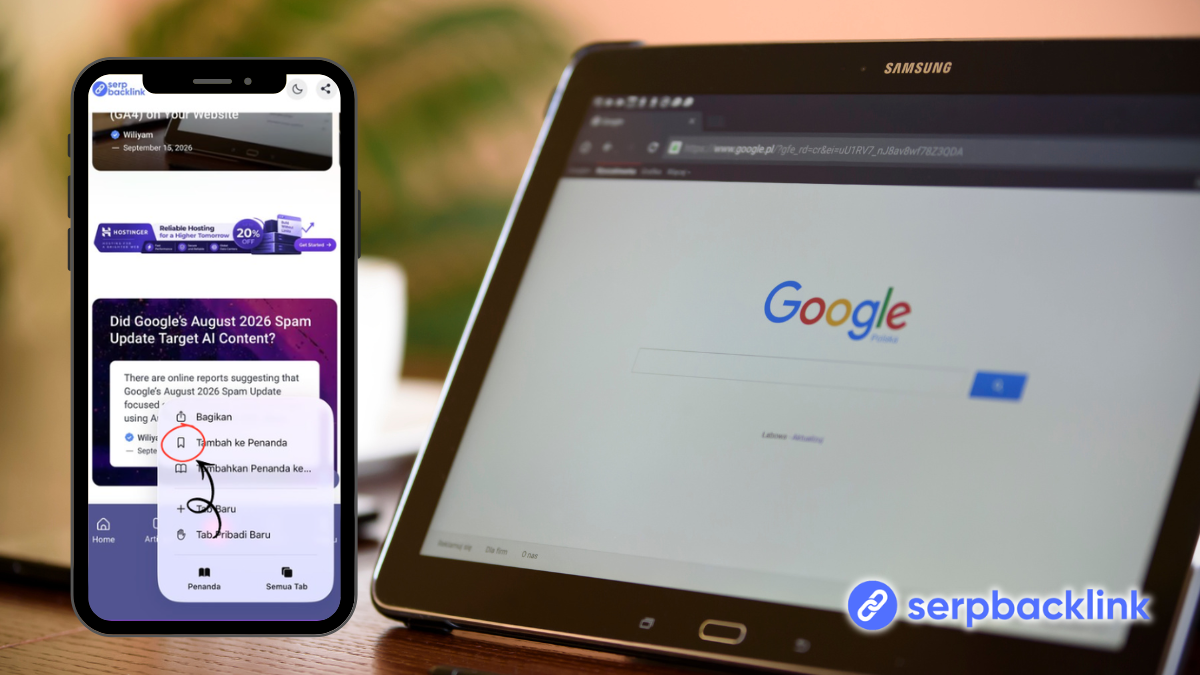
Could the number of people bookmarking a website in Google Chrome affect its position in Google Search?

At first glance, the idea doesn’t sound completely crazy. If people save a website for later, perhaps Google could see that behavior as a sign that the site provides value.

But there’s a problem with that assumption. There is no solid evidence that Google uses the number of Chrome bookmarks as a ranking factor.

The confusion mostly comes from an old Google patent that mentioned bookmarks, personalization, and search rankings. Some websites took that information and turned it into a much bigger SEO claim.

Let’s take a closer look at where the idea came from and why it doesn’t hold up.

The Claim That Chrome Bookmarks Can Boost Rankings

Some websites discussing this topic have claimed that Google stores bookmark information and uses it to influence search rankings.

The basic argument goes like this: Chrome collects browsing-related information, Google has access to Chrome data, and bookmarked websites could therefore receive a ranking boost.

It sounds technical, but technical language doesn’t automatically make a claim accurate.

The theory appears to come from an old Google patent titled “Search customisation based on user profiles and personalisation.”

The patent, which dates back to 2006, included references to bookmarks and ranking. That detail later became the foundation for claims that Google could use bookmark counts as a direct ranking signal.

Here’s where it gets interesting: a patent doesn’t tell us exactly how Google’s current search algorithm works.

Read more: Google Says AI Search Is Driving Billions of Clicks Every Week

What Does the Google Patent Actually Prove?

Google filed the “Search customisation based on user profiles and personalisation” patent in 2006. The patent included ideas related to user profiles, personalization, bookmarks, and search results.

The patent later changed ownership in 2017 and now carries an abandoned status.

That alone should make anyone cautious about using it as evidence of a current Google ranking factor.

Companies file patents to protect ideas they develop or explore. They don’t necessarily turn every patented concept into a live product or ranking system.

Even when a company eventually uses a patented technology, the final implementation may differ from the original patent. The technology could also serve another purpose entirely.

Other companies have referenced related concepts too. IBM, for example, published “Method, system, and program for ordering search results using an importance weighting” in 2004. Microsoft later referenced similar ideas in “Mobile friendly internet searches” in 2005.

Those references make the history interesting, but they don’t prove that Google currently rewards websites based on Chrome bookmark counts.

A Google Patent Doesn’t Automatically Equal a Ranking Factor

This distinction gets overlooked surprisingly often in SEO discussions.

Finding a Google patent that mentions a particular technology doesn’t mean you can add that technology to a list of confirmed Google ranking factors.

A patent describes an idea or method that a company wanted to protect. It doesn’t guarantee that the company deployed the idea in its search algorithm.

That’s why the bookmark theory falls apart when someone uses the old patent as its main piece of evidence.

The patent shows that Google explored ways to use user information for search personalization. It doesn’t prove that Google currently counts how many times people bookmark a website in Chrome and then uses that number to rank the site.

Read More: Understanding Outbound Links (External Links) and How They Differ from Backlinks

Why Bookmark Counts Wouldn’t Make Much Sense as a Ranking Signal

There’s another issue worth considering.

Google already has access to many types of information surrounding Search behavior. Search queries, devices, locations, previous interactions, and website activity can provide much more useful context than a simple bookmark.

A bookmark tells Google very little about the user’s intention.

A Bookmark Doesn’t Explain Why Someone Saved a Website

Imagine someone bookmarks a website about eggs.

What does that action actually tell Google?

The person might want to buy eggs. They could be researching poultry farming. Maybe they’re preparing an article. Or perhaps they simply like the website and want to visit it again.

The bookmark doesn’t explain the reason.

That’s a major weakness if someone wants to use bookmark counts as a search-ranking signal.

Google needs context to understand whether a page actually matches a user’s intent. A raw bookmark doesn’t provide much of it.

Compare that with a search query such as “how to start an egg farm.”

The query gives Google a much clearer idea of what the user wants. The search engine can then compare that intent with available pages and other relevant signals.

A bookmark can’t provide the same level of context.

Bookmark Data Would Be Easy to Manipulate

There’s also the spam problem.

Imagine Google announced that websites with more Chrome bookmarks could rank higher.

SEO sellers would probably notice very quickly.

Services promising thousands of bookmarks could appear. Automated tools could generate fake bookmarking activity. Website owners might start buying bookmarks in the same way some people have historically bought backlinks.

That would turn bookmarks into another metric that marketers could manipulate.

Google has spent years fighting attempts to manipulate search signals. A ranking factor that anyone could artificially inflate would create an obvious problem.

For that reason alone, treating raw bookmark volume as a major ranking signal doesn’t make much sense.

Read More: Can Having More Images in an Article Improve Google Rankings?

So, Does Bookmarking Help SEO?

Not based on the evidence discussed here.

The number of times people bookmark your website in Chrome isn’t a proven Google Search ranking factor.

The old Google patent doesn’t establish that Google currently counts Chrome bookmarks and uses the total to improve a website’s position in the SERPs.

For SEO professionals and website owners, there’s a useful lesson here.

Don’t turn every Google patent into an SEO tactic. A patent can reveal an interesting technology Google explored, but it doesn’t automatically reveal what Google’s current ranking systems use.

So if someone tells you to generate thousands of Chrome bookmarks to improve your Google rankings, there’s no strong evidence to support spending your time or money on it.

You’re better off focusing on things that genuinely help your website: useful content, clear search intent, a solid technical foundation, and a good experience for the people who actually visit your pages.

That’s a much safer SEO strategy than chasing another ranking-factor myth.

Reference:

Are Chrome Bookmarks a Google Ranking Factor?

Tagged with:
Google Rankings

An SEO Specialist & PR Strategist with over 6 years of experience in outreach guest posting, link building, and content marketing. Focused on building brand awareness through measurable digital marketing strategies. With a background in journalism and a wide professional network.


One thought on “Does Bookmarking a Website in Chrome Affect Google Search Rankings?”

Leave a Reply

Your email address will not be published. Required fields are marked *

You might also like
How Long Do Backlinks Take to Work? A Practical SEO Timeline

How Long Do Backlinks Take to Work? A Practical SEO Timeline

How to Find Outbound Links on a Site: A Practical Guide

How to Find Outbound Links on a Site: A Practical Guide

Many Websites Implement llms.txt Incorrectly: What You Should Know

Many Websites Implement llms.txt Incorrectly: What You Should Know

Semantic SEO: A Practical Approach to Search Intent, Context, and Entities

Semantic SEO: A Practical Approach to Search Intent, Context, and Entities