5 AI Detectors for SEO Writers: Tools, Accuracy, and What They Can Actually Tell You

AI detectors can be useful for SEO writers, but they are often misunderstood. A detector may estimate that a piece of content resembles AI-generated writing, yet that does not automatically mean the article was written by AI. Likewise, a low AI score does not prove that a human wrote every sentence.
For SEO writers, the more useful question is not simply, “Which AI detector gives the lowest score?” It is whether the content is original, useful, accurate, readable, and genuinely helpful to people.
That distinction matters because AI detection tools can produce different results on the same article. Factors such as editing, sentence structure, language, article length, and the detector’s own methodology can affect the result.
In this guide, we’ll look at five AI detectors that SEO writers may encounter, what each tool is designed to do, where it can be useful, and why you should avoid treating an AI-detection percentage as a definitive verdict.
What Is an AI Detector?
An AI detector is a software tool that analyzes text and estimates whether the writing contains patterns associated with text generated by artificial intelligence.
Depending on the tool, the analysis may consider characteristics such as sentence predictability, wording patterns, sentence variation, and other statistical or linguistic signals.
But there is an important limitation: AI detectors do not have a reliable way to look at a finished article and know with certainty who wrote it.
That is why an AI detector should be treated as an analytical aid rather than an authorship verification system.
Why AI Detection Matters to SEO Writers
SEO writers have a slightly different problem from someone simply checking whether a paragraph was generated by an AI tool.
An SEO article needs to satisfy several requirements at once:
Also Read: What You Need Before Adding Google Analytics
- Answer the searcher’s actual question.
- Provide accurate and useful information.
- Use natural language.
- Demonstrate appropriate expertise and context.
- Avoid unnecessary repetition and keyword stuffing.
- Be easy to read and navigate.
- Provide original value rather than simply rearranging existing content.
AI detection can be one small part of the editorial process. It should not become the entire process.
For example, an SEO writer might rewrite an article repeatedly just to reduce an AI detector’s score. The result could technically look “more human” to one detector while becoming less clear and less useful to the actual reader.
That is usually the wrong optimization target.
5 AI Detectors SEO Writers Can Use
There are many AI detection services available, but the following five are among the tools commonly encountered by writers, editors, publishers, and content teams.
| AI Detector | Useful For | What to Keep in Mind |
|---|---|---|
| GPTZero | General AI-writing analysis and education-related use cases | Detection is probabilistic, not definitive |
| Originality.ai | Publishers, SEO teams, and content workflows | Useful as part of an editorial process rather than as proof of authorship |
| Copyleaks AI Detector | AI-content and plagiarism checking | Results can vary depending on the text and language |
| Winston AI | Content review and AI detection | Detection scores should be interpreted carefully |
| QuillBot AI Detector | Quick checks for writers and editors | A useful signal, but not an authorship guarantee |
1. GPTZero

GPTZero is an AI-content detection service that has become particularly well known in education and writing-related environments.
For an SEO writer, its main use is straightforward: paste or submit text and examine whether the system identifies characteristics associated with AI-generated writing.
It can be useful when an editor wants an additional signal before reviewing a piece of content manually.
What SEO Writers Can Use It For
- Checking a draft before publication.
- Comparing an original draft with a heavily edited version.
- Identifying passages that may warrant additional human review.
- Adding another data point to a broader editorial workflow.
However, a GPTZero result should not be interpreted as proof that a particular writer used AI. Detection systems can make both false-positive and false-negative classifications.
2. Originality.ai
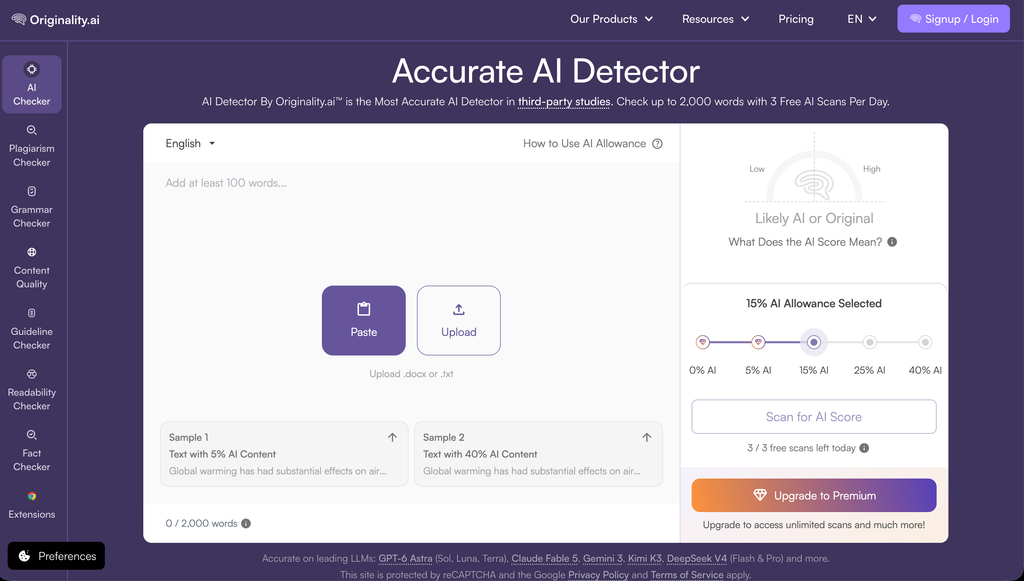
Originality.ai is particularly relevant to SEO publishers and content teams because it combines AI-content detection with other content-quality and originality-oriented features.
That makes the platform interesting for websites that publish a large amount of commercial, affiliate, informational, or SEO content.
For a publisher, the value is not necessarily the AI percentage itself. A larger content operation may benefit more from having a structured review process where AI detection is combined with plagiarism checking, editorial review, and fact checking.
Where It Can Help
Imagine an agency receives 100 articles from several freelance writers. An editor could use automated tools as an initial screening layer, then manually inspect content that raises questions.
That is a much more sensible workflow than automatically rejecting every article that receives a high AI probability.
3. Copyleaks AI Detector
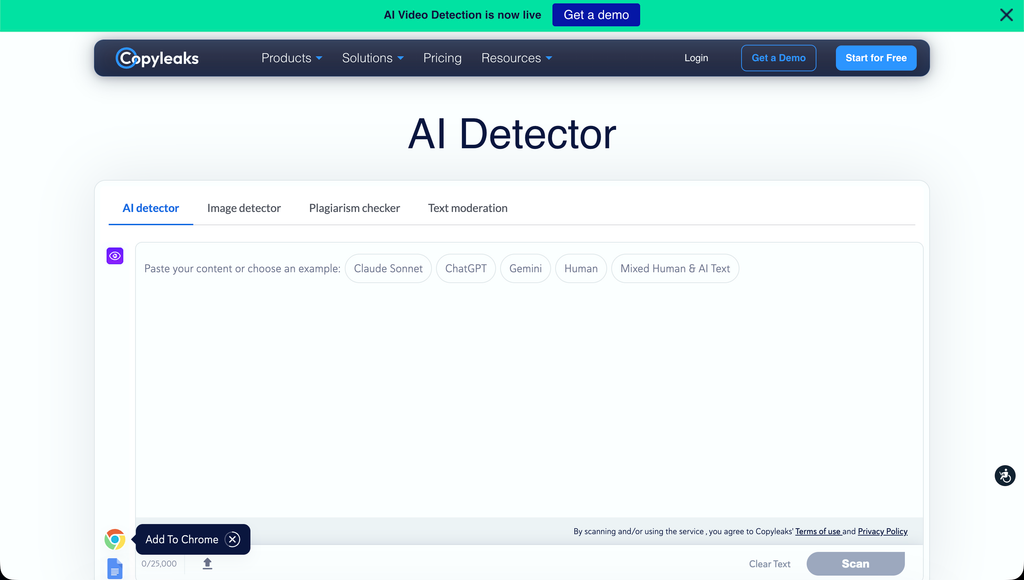
Copyleaks provides AI-content detection alongside plagiarism and text-analysis capabilities.
This combination can be useful for publishers because AI detection and plagiarism detection answer different questions.
Also Read: 8 AI Detection Tools Recommended by Ahrefs
An AI detector is attempting to estimate whether writing resembles AI-generated text. A plagiarism checker, on the other hand, looks for similarities between submitted content and existing material.
Those are not the same thing.
An article can be entirely human-written and still contain copied material. Conversely, AI-generated content can be substantially rewritten and may not trigger a straightforward plagiarism match.
For SEO editors, keeping these checks separate is important.
4. Winston AI
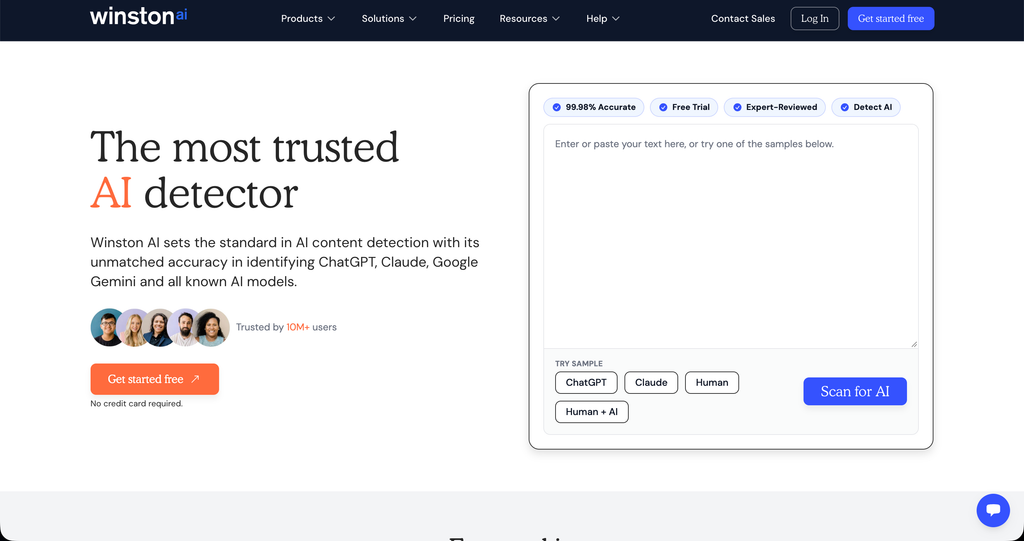
Winston AI is another service designed to analyze text for patterns associated with AI-generated content.
It can be useful when an editor wants another perspective on a piece of writing, particularly when different detection tools produce conflicting results.
And that conflict is actually worth paying attention to.
If one detector reports a very high probability of AI-generated text while another reports a much lower probability, the disagreement itself is a reminder that these systems are estimates rather than direct measurements of authorship.
Why Multiple Detectors Can Disagree
Different companies use different detection methodologies, models, thresholds, and datasets. They may also behave differently depending on the language and writing style.
As a result, there is no universal “AI percentage” that can be treated as an objective measurement of a document.
5. QuillBot AI Detector
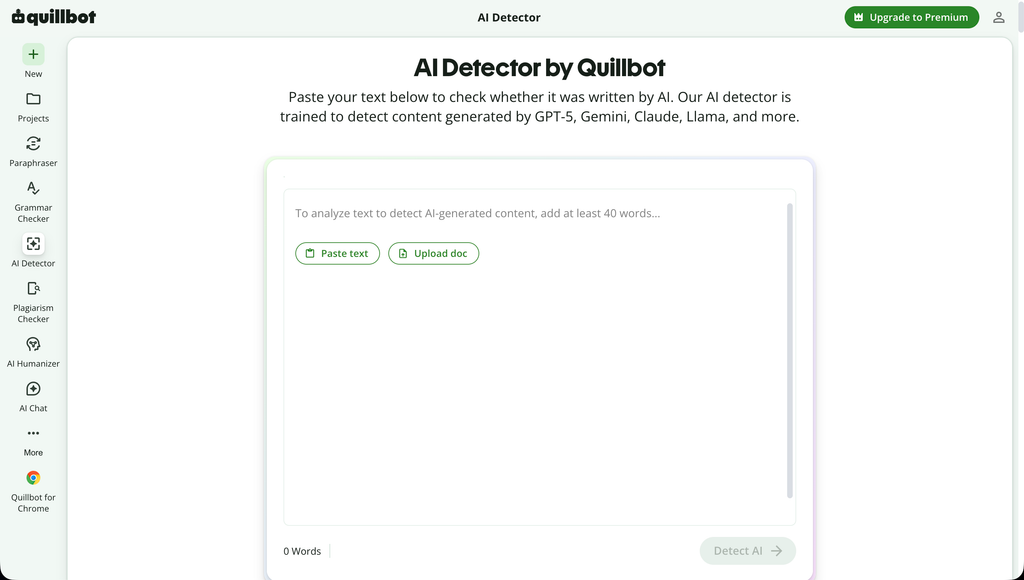
QuillBot is widely known for writing and paraphrasing tools, and its platform also includes AI-content detection.
For individual SEO writers, its appeal is simplicity. It can be used as a quick additional check while editing an article.
That can be helpful when you are trying to identify passages that sound overly formulaic or repetitive.
But there is an important distinction: improving writing because it sounds robotic is useful; rewriting sentences solely to manipulate a detector is much less useful.
Which AI Detector Is Best for SEO Writers?
There is no universal winner that can be declared the “most accurate” AI detector for every SEO workflow.
The appropriate tool depends on what you are trying to accomplish.
| Your Goal | What to Consider |
|---|---|
| Quick personal check | Choose a detector that is easy to access and fits your writing workflow. |
| SEO agency workflow | Look for content analysis, reporting, and workflow features in addition to AI detection. |
| Publisher quality control | Consider combining AI detection with plagiarism checks and human editorial review. |
| Freelancer screening | Use detector results as a signal, not automatic evidence of misconduct. |
If you are running a serious content operation, the better question is therefore not “Which detector gives me the lowest AI score?” but “Which workflow helps me publish better content?”
Are AI Detectors 100% Accurate?
No.
This is probably the most important thing to understand before using any AI detector.
Detection systems can produce false positives, meaning human-written text may be classified as AI-generated. They can also produce false negatives, where AI-assisted or AI-generated text is not identified.
The risk can become more complicated when content has been heavily edited, translated, paraphrased, or produced in a language that the detector handles differently.
For that reason, an AI score should not be used as the sole basis for accusing a writer of using AI or rejecting an article.
Does Google Penalize AI-Generated Content?
This is where SEO writers need to be careful with outdated advice.
Google’s guidance has historically focused on the quality and purpose of content, rather than simply whether a machine was involved in producing it.
The more relevant SEO question is whether the content provides useful information for people and follows Google’s spam policies.
Using AI as part of a writing workflow does not automatically make a page valuable or worthless. What matters is what ultimately gets published: its accuracy, usefulness, originality, purpose, and compliance with search-engine guidelines.
For the current position and policy details, SEO writers should check Google’s official documentation rather than relying on screenshots or old social-media posts.
Google Search Central: Creating helpful, reliable, people-first content
AI Detector Score vs. Content Quality
These two measurements should never be confused.
| AI Detector | Content Quality |
|---|---|
| Estimates whether text resembles AI-generated writing. | Measures whether the article actually helps the reader. |
| Can produce false positives. | Requires human judgment and context. |
| May vary between tools. | Depends on accuracy, relevance, clarity, depth, and usefulness. |
| Produces a detection result or probability. | Requires editorial evaluation. |
A technically “human” article can still be terrible SEO content.
It might contain outdated information, weak explanations, unnecessary fluff, copied ideas, poor structure, or keywords inserted into every other sentence.
Meanwhile, an article created with some AI assistance can potentially be edited into something genuinely useful.
That is why AI detection should never replace editorial judgment.
How SEO Writers Should Actually Use AI Detectors
If you want to use AI detection responsibly, treat it as one step in a larger content-quality workflow.
Step 1: Write for the Searcher
Start by understanding what the person searching actually wants.
If someone searches for “how to check domain authority,” they probably need more than a definition. They may want to know which metrics matter, which tools can be used, how to interpret the result, and what to do afterward.
That user need should shape the article.
Step 2: Add Useful Original Context
Don’t simply summarize what ten other websites already say.
Add explanations, examples, comparisons, practical considerations, limitations, and context that genuinely help the reader make sense of the subject.
Step 3: Edit for Natural Language
Read the article as a person would, not as an SEO checklist.
Remove repetitive phrases. Break up unnecessarily long explanations. Replace vague claims with specific information. Delete sentences that exist only because you felt the paragraph needed to be longer.
Step 4: Fact-Check the Important Claims
Check dates, product features, statistics, technical specifications, company statements, and other claims that could change or require evidence.
This is particularly important for technology and SEO articles because tools, algorithms, pricing, and platform policies can change.
Step 5: Use an AI Detector as an Additional Signal
At this point, you can run the article through one or more AI detectors.
If the result is unusual, don’t immediately rewrite the entire article. First inspect the passages that appear formulaic or unnatural.
Step 6: Perform a Human Editorial Review
Ask a much more important question:
Would a real reader find this article useful?
If the answer is no, lowering the AI score won’t fix the underlying problem.
Should You Rewrite an Article Until the AI Score Is 0%?
No.
Trying to reach a zero-percent AI score can become a pointless optimization exercise.
Different detectors can produce different results, and a piece of naturally written text may still be classified as AI-like by one system.
More importantly, deliberately manipulating text to satisfy a detector can damage readability.
For example, adding awkward sentence fragments, unnecessary slang, random punctuation, or unnatural wording may change a detector’s output while making the article worse for humans.
That’s backwards.
Your goal should be natural, useful writing. If the content genuinely needs editing, improve the writing itself rather than trying to fool a scoring system.
Common Mistakes SEO Writers Make With AI Detectors
1. Treating the Score as Proof
A detection score is an estimate. It is not a forensic certificate proving who wrote the text.
2. Using Only One Detector
A single tool can provide a useful signal, but relying on one result as the final verdict can be misleading.
3. Ignoring Content Quality
A low AI score does not make an article accurate, original, or useful.
4. Rewriting Everything After One High Score
First determine whether the writing actually has a problem. If it reads naturally and provides value, an unusual detector result deserves investigation rather than automatic rewriting.
5. Forgetting About Plagiarism
AI detection and plagiarism detection are different checks. If originality matters to your workflow, consider both.
6. Assuming AI-Assisted Writing Is Automatically Bad SEO
The quality of the finished page matters far more than simply identifying whether AI was involved somewhere in the production process.
A Better SEO Content Quality Checklist
Before publishing an article, run through this checklist:
- Does the article answer the search intent?
- Are the important claims accurate?
- Are current facts supported by reliable sources?
- Does the article explain concepts instead of merely mentioning keywords?
- Does it contain useful examples or practical context?
- Is the information organized logically?
- Are paragraphs easy to read?
- Are internal links genuinely useful?
- Are external sources authoritative where needed?
- Does the article avoid exaggerated promises?
- Does it provide something more useful than a generic summary?
- Has the content been reviewed by a human?
Notice that “AI detector score” isn’t at the top of that list.
That’s intentional.
Final Thoughts
AI detectors can be useful tools for SEO writers, editors, agencies, and publishers, but they should be used with the right expectations.
GPTZero, Originality.ai, Copyleaks, Winston AI, and QuillBot can all provide signals about whether text resembles AI-generated writing. However, their results should not be treated as definitive proof of authorship.
For SEO, the bigger issue is the quality of the finished article.
Does it answer the reader’s question? Is it accurate? Does it provide useful context? Is it original enough to offer genuine value? Does it avoid misleading claims? Can someone actually use the information?
Those questions matter much more than whether a detector reports 5%, 25%, or 80% AI probability.
Use AI detectors as a review tool, not as the definition of good writing.
Frequently Asked Questions
What is the best AI detector for SEO writers?
There is no single detector that is objectively best for every SEO workflow. GPTZero, Originality.ai, Copyleaks, Winston AI, and QuillBot each offer different approaches and features. The right choice depends on whether you need a quick personal check, publishing workflow, plagiarism detection, or broader content review.
Can AI detectors accurately identify AI-written content?
No detector should be treated as 100% accurate. AI detection is probabilistic and can produce both false positives and false negatives.
Should SEO writers try to get a 0% AI score?
No. A zero score is not a meaningful definition of high-quality writing. Focus on useful, accurate, natural, and original content instead.
Does AI-generated content automatically hurt SEO?
AI involvement by itself does not tell you whether a page is useful or poor quality. SEO writers should focus on creating content that satisfies users, provides accurate information, and follows applicable search-engine spam and quality guidelines.
Are AI detectors the same as plagiarism checkers?
No. AI detectors estimate whether writing resembles AI-generated text, while plagiarism checkers look for similarities with existing material. They address different questions and can be used together.
SEO Metadata
SEO Title: 5 AI Detectors for SEO Writers: What to Know
Meta Description: Compare 5 AI detectors for SEO writers, their uses and limitations, and learn how to use AI detection without sacrificing content quality.
Focus Keyphrase: AI detectors for SEO writers
Secondary Keywords: AI content detector, AI detector for writers, best AI detector, AI writing detection, SEO content checker, AI-generated content detector, AI detection tools, content quality checker
Suggested URL Slug: ai-detectors-for-seo-writers

An SEO Specialist & PR Strategist with over 6 years of experience in outreach guest posting, link building, and content marketing. Focused on building brand awareness through measurable digital marketing strategies. With a background in journalism and a wide professional network.